The French Revolution Oh! pleasant exercise of hope and joy! For mighty were the auxiliars which then stood Upon our side, we who were strong in love! Bliss was it in that dawn to be alive, But to be young was very heaven!—Oh! times, In which the meagre, stale, forbidding ways Of custom, law, and statute, took at once The attraction of a country in romance! When Reason seemed the most to assert her rights, When most intent on making of herself A prime Enchantress—to assist the work Which then was going forward in her name! Not favoured spots alone, but the whole earth, The beauty wore of promise, that which sets (As at some moment might not be unfelt Among the bowers of paradise itself ) The budding rose above the rose full blown. What temper at the prospect did not wake To happiness unthought of? The inert Were roused, and lively natures rapt away! They who had fed their childhood upon dreams, The playfellows of fancy, who had made All powers of swiftness, subtilty, and strength Their ministers,—who in lordly wise had stirred Among the grandest objects of the sense, And dealt with whatsoever they found there As if they had within some lurking right To wield it;—they, too, who, of gentle mood, Had watched all gentle motions, and to these Had fitted their own thoughts, schemers more wild, And in the region of their peaceful selves;— Now was it that both found, the meek and lofty Did both find, helpers to their heart’s desire, And stuff at hand, plastic as they could wish; Wcre called upon to exercise their skill, Not in Utopia, subterranean fields, Or some secreted island, Heaven knows where! But in the very world, which is the world Of all of us,—the place where in the end We find our happiness, or not at all!
http://www.youtube.com/watch?v=tfHnwqtJT9U Check out this Napoleon video!!!! |
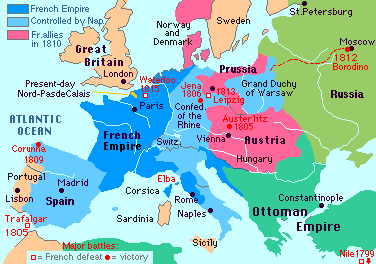 This map shows Napoleon's dominance over Europe during his rule. Napoleon Bonaparte Zack Long
Napoleon was born in Ajaccio, Corsica, on August 15th 1769 to Carlo Buonaparte, a lawyer and political opportunist, and his wife, Marie-Letizia. The Buonaparte's were a wealthy family from the Corsican nobility, although when compared to the great aristocracies of France Napoleon's kin were poor and pretentious. A combination of Carlo's social climbing, Letizia's adultery with the Comte de Marbeuf - Corsica's French military governor - and Napoleon's own ability enabled him to enter the military academy at Brienne in 1779. He moved to the Parisian École Royale Militaire in 1784 and graduated a year later as a second lieutenant in the artillery. Spurred on by his father's death in February 1785, the future emperor had completed in one year a course that often took three. By December 1793 Bonaparte was the hero of Toulon, a General and favourite of Augustin Robespierre; shortly after the wheel of revolution turned and Napoleon was arrested for treason. Tremendous political 'flexibility' saved him and the patronage of Vicomte Paul de Baras, soon to be one of France's three 'Directors', followed. Napoleon became a hero again in 1795, defending the government from angry counter-revolutionary forces; Baras rewarded Napoleon by promoting him to high military office, a position with access to the political spine of France. Bonaparte swiftly grew into one of the country's most respected military authorities - largely by never keeping his opinions to himself - and he married Josephine de Beauharnais. Commentators have considered this an unusual match ever since. In 1796 France attacked Austria. Napoleon was given command of the Army of Italy - the post he wanted - whereupon he welded a young, starving and disgruntled army into a force which won victory after victory against, theoretically stronger, Austrian opponents. Aside from the Battle of Arcole, where Napoleon was lucky rather than clever, the campaign is legitimately legendary. Napoleon returned to France in 1797 as the nation's brightest star, having fully emerged from the need for a patron. Ever a great self-publicist, he maintained the profile of a political independent, thanks partly to the newspapers he now ran. In May 1798 Napoleon left for a campaign in Egypt and Syria, prompted by his desire for fresh victories, the French need to threaten Britain's empire in India and the Directory's concerns that their famous general might seize power. The Egyptian campaign was a military failure (although it had a great cultural impact) and a change of government in France caused Bonaparte to leave - some might say abandon - his army and return in the August of 1799.
Having concluded treaties that left Europe at peace, Bonaparte began working on France, reforming the economy, legal system (the famous and enduring Code Napoleon), church, military, education and government. He studied and commented on minute details, often while traveling with the army and the reforms continued for most of his rule. Bonaparte exhibited an undeniable skill as both legislator and statesmen - a study of these achievements could rival those of his campaigns for size and depth - but many have argued that this talent was deeply flawed and even fervent supporters admit that Napoleon made mistakes. The Consul's popularity remained high - helped by his mastery of propaganda, but also genuine national support - and he was elected Consulate for life by the French people in 1802 and Emperor of France in 1804, a title which Bonaparte worked hard to maintain and glorify. Causes of the French Revolution Jake Gemballa
The French Revolution of 1789 had many long-range causes. Political, social, and economic conditions in France contributed to the discontent felt by many French people-especially those of the third estate. The ideas of the intellectuals of the Enlightenment brought new views to government and society. The American Revolution also influenced the coming of the French Revolution. The Philosophes planted the seeds for the French Revolution. Their goals were to expose and destroy the inequalities of the ancient regime. The three major causes of the French Revolution were political discontent, economic problems, and social class problems. The political discontent of France was one of the causes of the Revolution. In the 17th and 18th centuries, France was ruled by an absolute government. The king had all the political powers. Anyone who criticized the government could be arrested and put in prison without trial. Louis XVI was king at the time of the French Revolution. He was more interested in hunting than governing France. He and his Austrian queen, Marie Antoinette, lived an extravagant life at the Palace of Versailles. They did not really care about the state of their country. The French Parlement was called the Estates-General. It had not met since 1614 and couldn't without the consent of the king. At first, the votes in the assembly were not taken by head. The people of the 3rd estate felt a sense of betrayal when the king supported the block voting over the head voting. The first two estates worked together to outvote the large third estate to keep them from becoming a threat to the power. The French government was inefficient, unjust and corrupt. There were numerous government departments, different laws in different parts of the country and officials. Many people became livid at the way France was governed. The people couldn't do anything to bring about a change. The economic problems created by the French kings also contributed to the Revolution. During the 18th century, the French government spent more money than it collected in taxes. By 1788, the country was bankrupt. The amount of tax each person must pay was unfair. Landholders found in the nobility weren't taxed much. The Church owned one-tenth of the land in France and did not pay any taxes. The landholders found in the commoners were taxed heavily. The commoners dealt with a shortage of bread. The price of bread was a lot higher then one's ability to pay which caused great misery for the people of France. Most of the money was spent on wars. France had been at war for nearly 50 out of the previous one hundred years. France supported the Americans in the American War of the Independence. After that, France was in financial ruins. A large sum of money was also spent on palaces, entertainment and gifts by the king of France. Louis XVI tried to reform the taxation system but the nobility and the clergy refused to accept the new reforms. Therefore, the king was unable to make any financial reforms. The gabelle, salt tax, was also levied by the French Kings. When Jacques Turgot tried to impose the corvee, tax on land property, he was opposed by the nobility. He failed to pass the corvee and was dismissed by Louis XVI. Social problems were also a major factor that brought about the French Revolution. In the 18th century, France was a feudal country with class divisions. People were divided into three estates. The First Estate consisted of the clergy. The Second consisted of the nobility, and the Third included the bourgeoisie, the city workers and the peasants. The first estate was made up of 1% of the people and owned 10% of the land in France. The second estate consisted of 2% of the people and owned 35% of the land. The third estate held 97% of the people who owned 55% of the land. The people-to-land proportion was unjust looking at the amount of people in each estate. The third estate held very little land compared to the amount of people it had. It was overcrowded. The first and the second estate were the privileged classes. They clergy and the nobility were exempt from many taxes. They had to pay about four-fifths of their income on tax. They also needed to pay the land tax: also the taxes on property, roads, and salt. The third estate was the most discontented class. The bourgeoisie were well educated. They were strongly influenced by the ideas of Voltaire and Rousseau who attacked the injustices of the time. Rousseau believed that people are basically good but become corrupted by society. In an ideal society, people would make the laws and would obey them willingly. Probably the most famous of the philisophes was Francois-Marie Arouet who took the name Voltaire. He used biting wit as a weapon to expose the abuses of his day. He targeted corrupt officials and idle aristocrats. With his pen, he battled inequality, injustice, and superstition. He detested the slave trade and deplored religious prejudice. They resented the privileges of the nobility and wanted a larger role in state affairs. City workers were angry because their wages were not enough to buy goods when prices were going up rapidly. The peasants made up 80% of the population and had to pay heavy taxes. The working classes weren't able to control or start the Revolution. They were just starting to learn how to read. French peasants were subject to certain feudal dues, called banalities. These included the required used-for-payment of the lord's mill to grind grain and his oven to bake bread. The lord could also require a certain number of days each year of the peasant's labor. Peasants were targeted by society. They couldn't do anything on there own or try to fight back. The French Revolution was caused by social, political and economic problems. People were in discontent with the king. The first two estates were privileged and the third was very unprivileged and had to pay heavy taxes. The third estate did not get along with the first two. French kings spent a lot of money on wars. They spent more money then they made. It was time for a change in France.
|
|||||||||||||||||||||||||||||||||
The French Revolution May 05, 1789 - A meeting of the Estates-General was called by Louis XVI in Versailles to discuss and approve a new tax plan. June 17, 1789 - Three Poitevin curés decide to join the Third Estate, leaving the Chambers of the Clergy. Accepting the proposition of the delegate Abbé Sieyès, the Third Estate proclaims itself "The National Assembly." A few liberal nobles and many clergy join the movement of the Third Estate. Tennis Court Oath: After being locked out of their meeting room, deputies of the Third Estate assembled on a tennis court and swore not to separate until a constitutional regime was established. July 7 – 13, 1789 - The National Assembly appoints a committee of thirty members to draft a constitution. The National Assembly proclaims itself the Constituent National Assembly, with full authority and power to decree laws; their primary task is to draw up and adopt a constitution. Necker is dismissed. Demonstrations and speeches take place at the Palais–Royal. The electors of Paris form a standing committee and a citizens’ militia. July 14,1789 - The storming and fall of the Bastille. August 04,1789 - The end of feudalism and serfdom in France was announced by the National Assembly. August 27,1789 - The Declaration of the Rights of Man was issued by The National Assembly. October 5,1789 - The women of Paris invaded Versailles. Parisians, led by a large number of women, march upon Versailles and force the royal family back to Paris, where they take up residence at the Tuileries. Louis XVI is considered by many a "Prisoner" in Paris. The Assembly, still in Versailles, declares, in the spirit of constitutional monarchy, its inseparability from the king. 1790 - The Civil Constitution of the Clergy was passed. 1791 - The Constitution of 1791 was adopted. June 20,1791 - Louis XVI and his family were arrested while trying to flee from France. April 20, 1792 - France declared war on Austria. September 1792 - The First meeting of the National Convention was held. December 1972 - Commencement of the trial of Louis XVI. January 21, 1793 - Louis XVI sentenced to the guillotine. August 1793 - A National Draft was issued calling for all able-bodied men to enlist in the army.
July 27, 1794 - The National Convention arrested Robespierre. July 28, 1794 - Robespierre was beheaded. 1795 - A new Constitution was adopted. 1799 - The fall of the Directory heralds the end of the French Revolution.
Napoleonic Era
Works Cited Kagan, Donald, Steven E. Ozment, and Frank M. Turner. "Napoleon Bonaparte." The Western Heritage. Upper Saddle River, NJ: Pearson Prentice Hall, 2007. Print. "Napoleon Bonaparte." Google. Web. 08 Apr. 2011. <http://www.google.com/>. "Napoleon Bonaparte Song." YouTube - Broadcast Yourself. Web. 08 Apr. 2011. <http://www.youtube.com/>.
|
||||||||||||||||||||||||||||||||||

