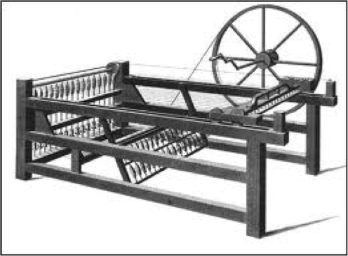
The Spinning Jenny
James Hargreaves new revolutionary invention will
increase your yarn output tremendously. Now your workers can tend to up to
eight spools of yarn. Now you can lower your cost of production and produce
even more yarn. Buy yours today at your nearest supplier. Visit supplier for
price.
The International
Arise, ye pris`ners of starvation!
Arise, ye wretched of the earth,
For Justice thunders condemnation,
A better world’s in birth.
No more tradition’s chain shall bind us.
Arise, ye slaves; No more in thrall!
The earth shall rise on new foundations,
We have been naught, we shall be all.
- Eugene Pottier, French poet (1816-1887),
From his poem "The International"
Credit: lancefuhrer.com
|
|
Check out this timeline below!!!!!!!!!
The First Industrial Revolution: Textiles and Steam: 1712-1830
- 1712: The Newcomen steam engine.
- 1733: John Kay invents the flying shuttle.
- 1764: James Hargreaves invents the spinning jenny.
- 1769: Richard Arkwright patents the water frame.
- James Watt patents a series of improvements on the Newcomen engine making it more efficient.
- 1779: Samuel Crompton perfects the spinning mule.
- 1785: Edmund Cartwright patents a power loom.
- 1793: Eli Whitney patents the cotton gin.
- 1807: Robert Fulton begins steamboat service on the Hudson River.
- 1830: George Stephenson begins rail service between Liverpool and London.
The Spread of the Industrial Revolution: 1830-1875
- 1840: Samuel Cunard begins transatlantic steamship service.
- 1856: Henry Bessemer develops the Bessemer converter.
- 1859: The first commercial oil well is drilled in Pennsylvania.
- 1866: The Siemens brothers improve steelmaking by developing the open hearth furnace.
Credit: thenagain.info
Quiz
1. Who invented the Spinning Jenny in 1768?
-James Hargreaves
2. What did Edmund Cartwright invent in 1787?
-Power Loom
3. What Scottish Engineer created the steam engine during the 1760’s?
-James Watt
4. The system developed by Henry Cort to purify iron was called what?
-puddling
5. Who helped develop the first public railroad known as the Rocket?
-George Stephenson
6. What year was the Great Convention held?
-1851
7. The Report on the Condition of the Labouring Population of Great Britain was written by whom?
-Edwin Chadwick
8. What two authors gave rise to so called Gothic literature?
-Edgar Allen Poe & Mary Wollstonecraft Shelley
9. Childe Harold’s Pilgrimage was written by whom?
-Lord Byron
10. Death of Sardanapalus was painted by whom?
-Eugene Delacroix
Credit: Ap European history book
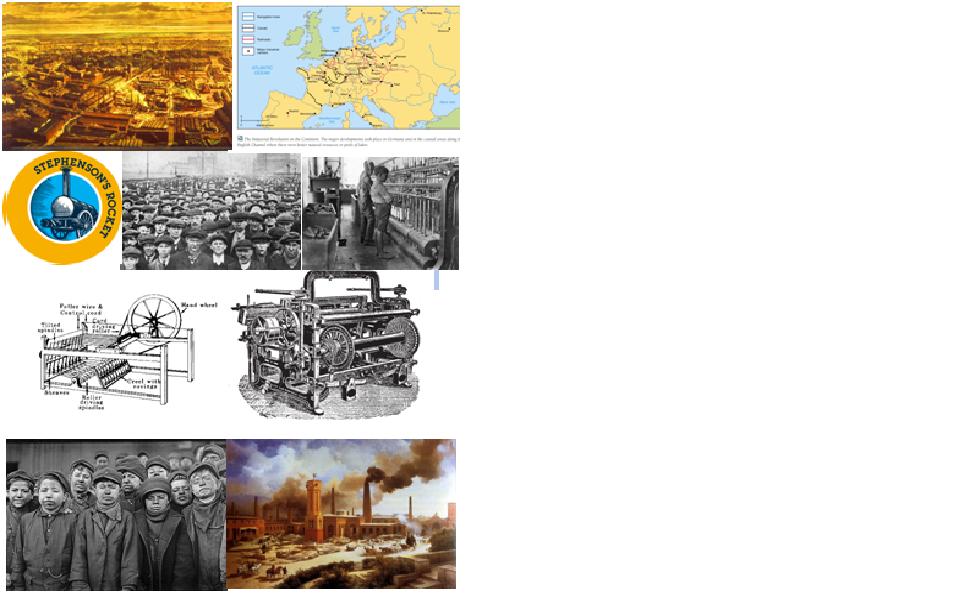
Interviews concerning the work conditions of the Industrial Revolution
How long have you been employed in a silk-mill?
More than thirty years.
Did you enter as a child?
Yes, betwixt five and six.
How many hours a day did you work then?
The same thirty years ago as now.
What are those hours?
Eleven hours per day and two over-hours: Over-hours are working after 6 in the evening till 8. The regular hours are from 6 in the morning to 6 in the evening, and two other are two over-hours: About 50 year ago they began working over hours.
What are the intervals for meals?
In our factory 20 minutes for breakfast at 8, 1 hour for dinner at 2, 20 minutes for tea at 5.
What are the effects for the present system of labor?
From my earliest recollections, I have found the effects to be awfully detrimental to the well-being of the operative; I have observed frequently children carried to factories unable to walk, and that entirely owing to excessive labor and confinement. The degradation of the workplace baffles all description: Frequently have two of my sisters been obliged to be assisted to the factory and home again, until bay-and-by they could no longer, being totally crippled in their legs. And in the next place, I remember some ten or 12 years ago working in one of the largest firms in Macclesfield, (Messrs. Baker and Pearson) with about 25 men, where there were scarce one half fit for His Majesty’s service. Those that are straight in the limbs are stunted in their growth; much inferior to their fathers in point of strength. Thirdly, through excessive labour and confinement there is often a total loss of appetite; a kind of langour steal over the whole frame – enters to the very core – saps the foundation of the best constitution – and lays our strength prostrate in the dust. In the 4th place, by prostrated labour there is an alarming increase of cripples in various parts of this town, which has come under my own observation and knowledge.
- Testimony by John Wright, a worker in an English Silk Factory, made to the Parliamentary Commission for Inquiry into the Employment of Children in Factories, 1833.
Credit: http://lancefuhrer.com/IR_docs.htm
Henry Cort died on May 23, at age 59, of natural causes. Mr. Cort passed away peacefully in his home last Sunday. He is succeeded by his ten of his twelve children and his wife, Elizabeth. Cort is known for his new method of refining iron known as puddling. Puddling is the process of refining pig iron from iron ore to bar iron, which is much stronger and has fewer impurities. Puddling involves first bringing the furnace to a low temperature and introducing iron oxides. Next, cast iron or refined iron is added to the hearth in the furnace. Then, the iron is heated until the top begins to melt. A strong current of air reacts with the oxides in the iron, which is further heated at this time. The added heat completely melts the iron, which is then formed into “puddle balls”. After the “puddle balls” are then cooled, they are reheated and formed into the desired shape. An expert watches over the process and removes large pieces of impurities. The quality of the process of shaping the iron can be improved by faggoting. Funeral arrangements will be held at the family’s home in Lancaster on Thursday from 6pm-8pm.
Credit: Henrycort.net
The Industrial Revolution was a significant period of time in Europe that introduced many new ideas into the world and Europe. Many new inventions and ideas spread that are still known and in use today. Although many new things were invented that changed the world, none other was more important than the new process of making iron called puddling, developed by Henry Cort.
Puddling is a method of developing pig iron and iron ore into wrought iron, also known as bar iron. This iron was much strong and of better quality than the pig iron. A furnace heated the iron into puddling balls. Impurities and slag were broken off. These puddling balls were then further heated and rolled into bars or beams. When they cooled, the iron was much stronger than the iron of other iron making processes.
Henry Cort’s new process of iron making made a significant impact on not only Europe, but the entire world. Because of this improvement in the development of iron, there was a greater demand for it. The Industrial Revolution saw many new inventions that used iron, such as the steam engine. Because the iron was now of better quality, so were the products it was involved in making. Henry Ford took advantage of these new processes and the assembly line and created the Ford Model T, which revolutionized the automobile industry. The new developments in iron also allowed for better and faster production techniques. This new development was extremely important to the world.
Puddling iron was extremely important to the world, not just Europe. There are many examples of the new structures that were made because of this stronger iron, like the Eiffel Tower. This new process led to many new developments in how to make stronger metals as well. Puddling iron was a precursor to construction steel that is used today in all new building structures. Therefore, puddling iron was also very important to help make the world as technologically advanced as it is today.
In conclusion, puddling iron was truly revolutionary. It helped spawn and influence the creation of many new inventions that led to life as we know it. This was a great period of time that had lasting effects on the world that are still visible to this day.
Steam Engine
Mitchell Butker
It is 19th Century Europe and the steam engine has just been developed. Inventors are astonished at all the new possibilities there are with this invention. The steam engine revolutionized the world of industry and transportation. Not only did stimulate Europe’s industrial era but also brought prosperity to America. Therefore, the steam engine was arguably the most important mechanical invention in the Industrial Revolution.
In the 1760’s the Scottish engineer James Watt created the steam engine. When Watt adapted his invention to include a rotary engine that could turn a shaft it enabled it to be applied to machinery. The steam engine could now be used to power cotton mills. This gave a big boost to the textile industry. Britain was now able to improve their production from 22 million pounds of cotton to 366 million pounds. This made cotton Britain’s most important product in value. These improvements in the textile industry helped all areas of European society.
Transportation was made faster and easier with the development of the steam engine. Locomotives were now made possible; at first they went only a maximum of 5 miles per hour. Better locomotives soon followed thanks to George Stephenson and his son. Stephenson’s Rocket sped along at an astonishing 16 miles per hour but within twenty years locomotives would reach 50 miles per hour. The 6,000 miles of railroads would become invaluable to the revolution. Not only would they improve transportation but the increase in needs for iron and coal would help the growth of these industries. Also, job opportunities became available for peasant and farm owners. The locomotive was made possible by the steam engine and helped strengthen the industrial revolution in many ways.
Factories were more important than ever now that the need for coal and iron were greater. The steam engine provided a greater output of products. Also, the steam engine could not get tired like regular workers. The only source of power needed was coal, which at this time seemed to be at an endless supply. Because of this the output of coal quadrupled between 1815 and 1850. Factory owners also faced a task. New machines created repetitive boring work for workers. Ways to discipline workers were used to make sure factories goals were accomplished.
In conclusion, the steam engine became the start of what would be a time of industrial growth and prosper for Europe and even America. Not only did it have a great affect during this time period but many if the same ideas are still seen today. Trains are still a big part of today’s society; many of you may have even seen one passing by recently. So as you can see the steam engine is one of the greatest and most useful inventions of the industrial revolution.
|